
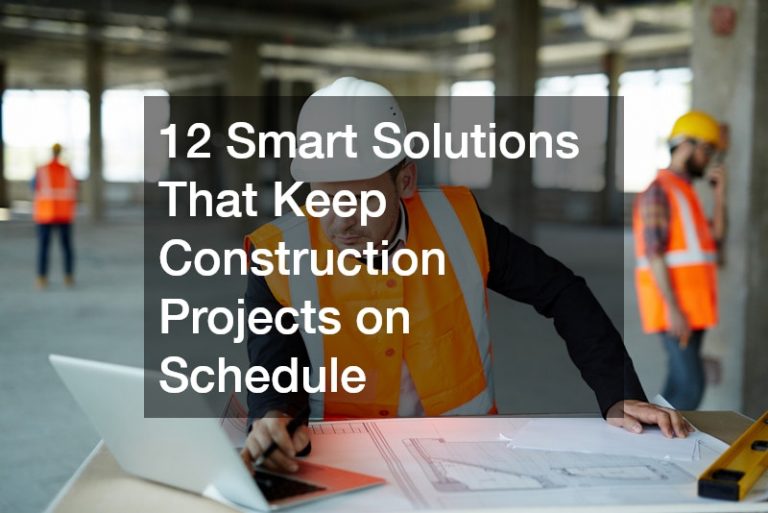
In the world of building and development, time is money. Every day a project runs over its deadline, the costs climb higher. Whether you are building a single-family home or a massive commercial complex, staying on schedule is the ultimate challenge. Delays can come from anywhere: bad weather, missing materials, or broken machinery. However, successful builders know that a “on-time” finish isn’t about luck; it is about smart planning and choosing the right partners.
For the readers of our construction blog, we have gathered twelve essential solutions to keep your timeline intact. By focusing on these strategies, you can navigate the “chaos” of a job site and ensure that your crew stays productive from the first shovel in the ground to the final coat of paint. Let’s dive into the smart solutions that keep modern projects moving forward.
1. Starting with Precise Site Clearances

You cannot build a future on the ruins of the past without a clean slate. Before the new structure can rise, the old one must go. Utilizing professional demolition services is the first step in a tight construction schedule. If the site isn’t cleared properly, your foundation crew will find buried debris, old pipes, or unstable soil that can stop a project for weeks.
- Safe and Swift Removal: Expert demolition services use specialized machinery to tear down structures in hours rather than days. They also handle the sorting of materials for recycling.
- Environmental Compliance: Pros ensure that hazardous materials like asbestos or lead are removed safely, preventing a surprise shutdown by government inspectors.
- Foundational Prep: Once the building is down, the demolition team levels the ground, allowing the next crew to start immediately without clearing away “leftover” rubble.
A clean, predictable site is the bedrock of a good schedule. When you start with professional clearing, you eliminate the “surprises” that usually pop up in the first month of work.
2. Implementing Proactive Environmental Protection
Nothing stops a construction site faster than a sudden storm. If your site isn’t prepared for heavy rain, you might find your trenches filled with mud and your expensive materials floating away. Advanced flood control measures are a smart solution for keeping the job site dry and workable, even in the “rainy season.”
- Silt Fences and Barriers: Installing proper flood control barriers keeps soil from washing away and prevents mud from spilling onto public roads, which avoids costly fines.
- Pumping Systems: Having high-capacity water pumps on standby ensures that if a pit does fill with water, it can be emptied in hours so work can resume the next morning.
- Temporary Drainage: Creating gravel-lined channels directs water away from the active building zone, protecting the integrity of your freshly poured concrete or dug-out footings.
Managing water is about more than just staying dry; it’s about protecting the work you’ve already finished. A flooded site can set a schedule back by weeks as you wait for the ground to dry out.
3. Streamlining the Supply Chain for Critical Items

One of the most common reasons for a project delay is “waiting for stuff.” If your crew is sitting around because the lumber or the drywall hasn’t arrived, you are losing money. Managing your building supplies with a “just-in-time” delivery strategy ensures that the materials arrive exactly when they are needed—not too early to get in the way, and not too late to stop the work.
- Inventory Management: Use software to track your building supplies. This tells you exactly when you are running low on nails, rebar, or plywood before it becomes a crisis.
- Vetted Vendors: Work with suppliers who have a proven track record of on-time delivery. A cheap supplier who is always late is actually the most expensive choice.
- On-Site Storage: For items prone to theft or weather damage, ensure you have secure, weatherproof containers ready so that materials stay in “ready-to-use” condition.
When your materials flow smoothly, your labor flows smoothly. Keeping a steady pulse on your supplies is the key to maintaining a high “burn rate” of productivity on the job site.
4. Coordinating Specialized Power and Systems
Modern buildings are complex machines filled with wiring, sensors, and data cables. Bringing in electrical contractors early in the design phase prevents “clashes” where pipes and wires try to occupy the same space. Coordination between the trades is vital to ensure that the lights turn on the day the building is supposed to open.
- Early Rough-In: Experienced electrical contractors know how to work around the framing crew to get wires pulled fast, allowing the drywall team to move in right behind them.
- Temporary Power: You need electricity to run tools and heaters. Your electrical team should set up a safe, temporary power grid on day one so the crew isn’t fighting over a single extension cord.
- Safety Inspections: Pros handle the “permitting” process, ensuring that the work passes local codes on the first try so you don’t have to tear down walls for a “re-do.”
Electrical work is often the “long pole in the tent” for a construction schedule. If the power isn’t ready, nothing else can be finished. Smart coordination keeps the sparks flying in a good way.
5. Utilizing High-Strength Structural Fabrication
Steel is the skeleton of many modern buildings, and getting that skeleton to fit together perfectly requires precision. Professional welding services are essential for both structural integrity and the speed of the build. On-site welding allows for custom adjustments that “kit” buildings simply cannot offer.
- Structural Integrity: Expert welding services ensure that every joint can handle the load-bearing requirements of the building, preventing structural failures that would cause massive delays.
- On-Site Modifications: If a steel beam arrives slightly off-spec, a skilled welder can fix the issue right there on the site, saving the days or weeks it would take to ship a new part.
- Specialized Fabrication: From staircases to roof supports, custom welding allows the project to move forward without waiting for specialized factory-ordered parts.
A fast-moving project needs a strong frame. When the steel goes up quickly and securely, every other trade—from masonry to windows—can follow along right on schedule.
6. Managing the Complexities of Residential Builds

Building a house is different from building a skyscraper. In home construction, you are often dealing with smaller lots, closer neighbors, and very specific finishes. A smart solution for residential builders is “phased scheduling,” where every small task is mapped out so that no two crews are tripping over each other in a small kitchen or bathroom.
- Subcontractor Synergy: In home construction, timing the plumber, the HVAC tech, and the electrician is an art form. Using a master schedule ensures that the plumber finishes the pipes before the bathtub is installed.
- Client Communication: Keeping the homeowner informed prevents “change orders” halfway through the build. A change in tile or cabinet color on day 50 can set a project back 20 days.
- Quality Control: Regular walk-throughs ensure that mistakes are caught while the walls are still open, which is much faster and cheaper to fix than after the house is done.
Building a home is personal. By staying on a strict schedule, you reduce the stress on the family and ensure that “move-in day” happens exactly when the calendar says it will.
7. Ensuring Smooth Access for Logistics
If the delivery trucks can’t get into the site because the driveway is a mud pit, your project will stall. Investing in early paving services for access roads and staging areas is a brilliant way to keep the site “logistically sound.” This allows heavy trucks to move in and out regardless of the weather.
- Heavy-Duty Access: Professional paving services can create temporary asphalt or gravel pads that hold the weight of 80,000-pound delivery trucks without sinking.
- Staging Areas: Having a paved area for material storage keeps your building supplies out of the mud, which makes them easier to move with a forklift.
- Final Finishing: By planning your permanent paving early, you can often use the same crew to finish the sidewalks and parking lots right as the building is being completed.
Good “site flow” is about movement. If the trucks are moving, the project is moving. Paved surfaces are the “arteries” that keep the lifeblood of materials flowing into the heart of the job.
8. Keeping the Iron Moving with Expert Maintenance
Construction is a battle between man and machine. If your excavator or crane breaks down, the “work” stops immediately. A dedicated heavy equipment service plan is the best way to prevent the “down-time” that kills a schedule. You should never wait for a machine to break to fix it; you should fix it so it doesn’t break.
- Preventative Maintenance: A mobile heavy equipment service can visit the site after hours to change oil, check hydraulic lines, and grease joints so the machines are ready for the 6:00 AM start.
- On-Site Repairs: If a hose blows, you need a technician who can get to the site with parts in an hour. Waiting for a tow truck to haul a bulldozer to a shop is a schedule-killer.
- Equipment Lifecycle: Tracking the hours on your machines allows you to rotate them before they reach the “failure point,” ensuring that only the most reliable “iron” is on the critical path.
Every hour an operator sits in a broken machine is an hour of lost profit. Smart builders treat their machinery like the high-performance tools they are.
9. Focusing on the Building’s Thermal Envelope

As the building gets “closed in,” the focus shifts to efficiency and comfort. This is where an insulation expert becomes the MVP of the schedule. Installing the “envelope” of the building correctly the first time prevents “air leaks” that would fail a pressure test later, which would require tearing out drywall to find the hole.
- Material Variety: An insulation expert knows whether to use fiberglass batts, spray foam, or blown-in cellulose to get the best R-value for the specific project.
- Air Sealing: Modern codes are strict about air leakage. Pros use specialized tapes and foams to seal the gaps around windows and doors before the “finish” work begins.
- Acoustic Comfort: In multi-family builds, insulation is also about sound. Proper installation between units ensures privacy and meets the “decibel” requirements of the project.
A well-insulated building is easier to heat and cool during the final phases of construction, which makes the environment better for the crews doing the delicate finish work like painting and cabinetry.
10. Establishing Perfect Boundaries and Grids
You cannot build a straight building on a crooked line. The very first person on a site should be a land surveyor, and they should return several times throughout the project. They provide the “truth” of the land, ensuring that the foundation is exactly where the blueprints say it should be.
- Boundary Disputes: A land surveyor prevents the nightmare of building a wall six inches onto the neighbor’s property, which would result in a legal “stop-work” order.
- Elevation Accuracy: Surveyors ensure that the building is at the right height for proper drainage. If a building is too low, it will flood; if it’s too high, the “ADA” ramps won’t fit.
- Utility Staking: They mark exactly where the water, gas, and power lines enter the property, so the digging crew doesn’t accidentally hit a live “utility” and shut down the neighborhood.
Accuracy is the mother of speed. When the lines are drawn correctly from day one, every other trade can work with the confidence that they are in the right spot.
11. Embracing Technology and Building Information Modeling (BIM)
In the modern era, we build the building “twice”—once in the computer and once in the dirt. BIM software allows the home construction team and commercial contractors to see the entire project in 3D before a single nail is driven. This “digital twin” is a master solution for avoiding the “clashes” that lead to delays.
- Conflict Resolution: BIM shows if a duct is going to hit a steel beam. Fixing this on a computer screen takes ten minutes; fixing it on a job site takes three days and a lot of money.
- Material Precision: Technology allows you to order exactly the right amount of building supplies, reducing waste and ensuring you don’t run out of materials at the last minute.
- Real-Time Updates: Cloud-based schedules allow every subcontractor to see changes on their smartphone instantly, ensuring everyone is working from the latest set of “blueprints.”
Technology doesn’t replace hard work, but it makes hard work more efficient. It removes the “guesswork” that often leads to the “wait-and-see” delays that plague old-school projects.
12. Prioritizing Safety to Prevent Stop-Work Orders
The fastest way to ruin a construction schedule is to have an accident. An injury on-site is a tragedy for the worker and a disaster for the timeline. A “Safety First” culture isn’t just about being nice; it’s a smart business solution. A safe site is an organized site, and an organized site is a fast site.
- Daily Toolbox Talks: Spend ten minutes every morning discussing the hazards of the day. This keeps safety “top of mind” for every worker, from the electrical contractors to the paving crew.
- Proper PPE: Ensure everyone has hard hats, high-visibility vests, and eye protection. A “minor” eye injury can still shut down a crew for a day of paperwork and hospital visits.
- Clean Workspaces: Slips and trips are the leading cause of construction injuries. Keeping the site clear of “trash” and scrap wood prevents the accidents that lead to OSHA inspections and shutdowns.
When workers feel safe, they work faster and better. A project with a “zero-accident” record is almost always the project that finishes on or before the deadline.
Managing the “Critical Path” for Success
In construction management, we use a term called the “Critical Path.” This is the sequence of stages that determines the minimum time needed for the project. If any task on this path is delayed, the whole project is delayed. Smart builders focus their energy on these “bottleneck” areas.
- Preparation: This includes your land surveyor and demolition services. If these aren’t done right, nothing else can happen.
- Infrastructure: Getting the flood control and paving services set up ensures the site remains accessible and dry.
- The Skeleton: This is where welding services and structural framing happen. It’s the most visual part of the schedule.
- Systems: Electrical contractors and plumbers fill the walls with the “guts” of the building.
- The Shell: An insulation expert and the roofing crew seal the building from the weather.
- The Finish: This is the “home stretch” where the painting, flooring, and landscaping occur.
By understanding how these steps fit together, you can anticipate problems before they happen. For example, you should be talking to your insulation expert while the welding services crew is still finishing the frame.
Conclusion
Finishing a construction project on schedule is one of the hardest jobs in the world. It requires a mix of “heavy lifting” and high-level thinking. By utilizing smart solutions—from the precision of a land surveyor to the specialized skills of electrical contractors—you create a “rhythm” on the job site that is hard to break.
Remember that every partner you choose matters. Whether you are hiring demolition services for a fresh start, welding services for a strong frame, or an insulation expert for a tight envelope, quality work prevents the “re-dos” that kill a timeline. Managing your building supplies and keeping your “iron” running with a heavy equipment service ensures that the work never stops.
Finally, by focusing on the “big picture” items like flood control, paving services, and site-wide safety, you protect your project from the “outside” forces that cause delays. Construction is about building the future. When you build on schedule, you build a reputation for excellence that will bring you more work for years to come.